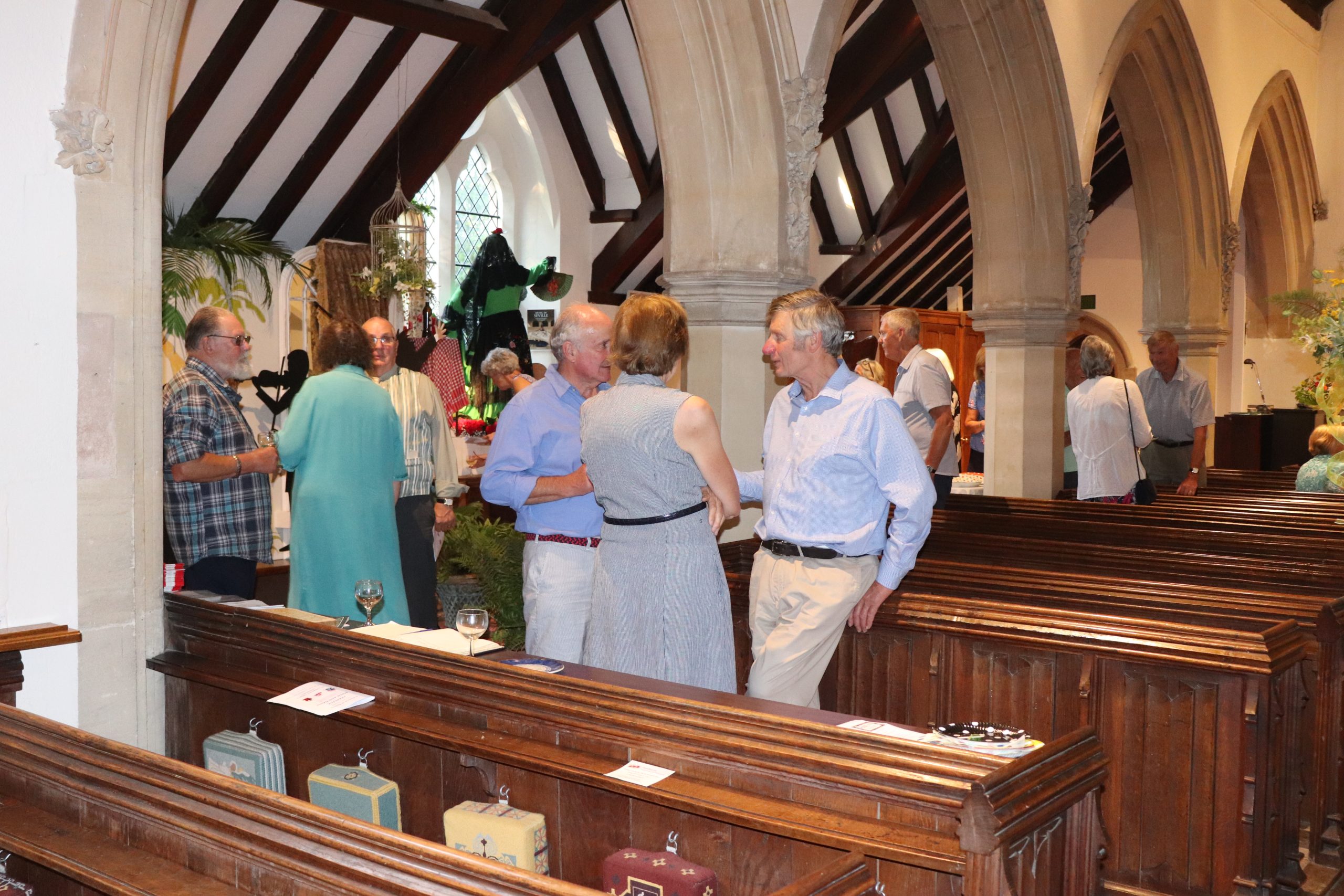
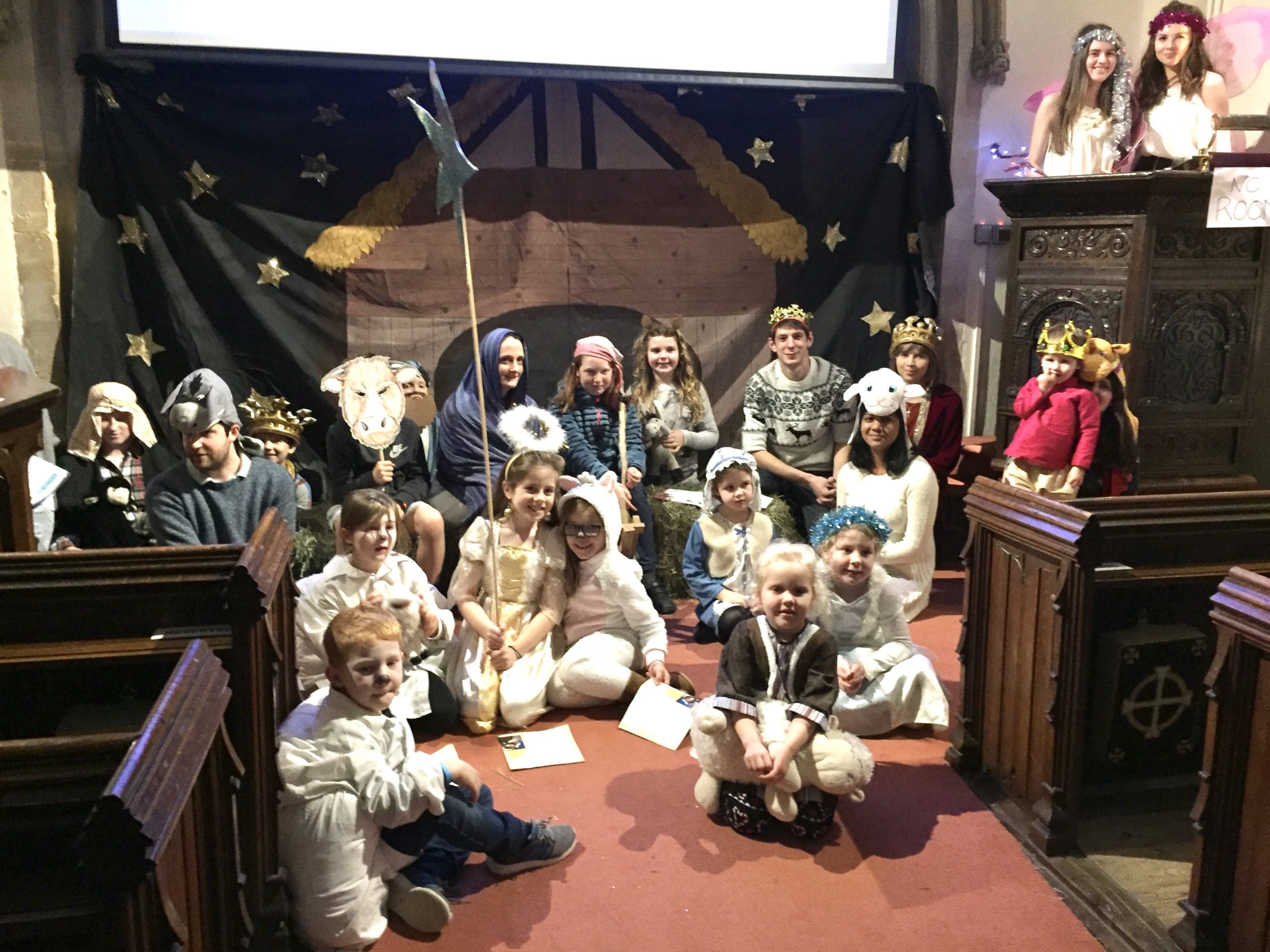
The original church was built in the Saxon period in the mid 1300’s, but little of this original structure remains. It was substantially rebuilt and enlarged in 1858 under the direction of local architects Fulljames and Waller.
In its earliest days Sandhurst Church belonged to St. Oswold’s Priory in Gloucester, from which a chaplain was sent out to minister to the people. The present building is partly 14th century, but was mainly rebuilt in 1858. The belfry holds a ring of 8 bells. A team regularly ring for the main services, and also for special occasions. In 1996 a churchyard survey was carried out, when all memorials and their inscriptions were recorded, a copy of this is in the church and a map and index of names are on the back of the notice board in the car park. This was updated in 2017 and a complete index of names is kept in the church.

 .
.
Of note in the church:
The baptismal font is made from lead and dates from the 12th-century Norman period; such fonts are rare with only about 30 to be found in England. This is one of six of identical patterned fonts around Gloucestershire. The font was cast in lead, flat sheets of lead being bent into a cylinder. To create repeated patterns carved wood moulds were used. The decorative panels are an arcade of eleven compartments, showing seated figures each with right hand raised and book on its knee. Alternating panels have a foliate “S” scroll, and a foliate frieze can be seen at the top and bottom of the panels. Lead fonts are rare, the most likely reason being that many were melted down for ammunition during the English Civil War.
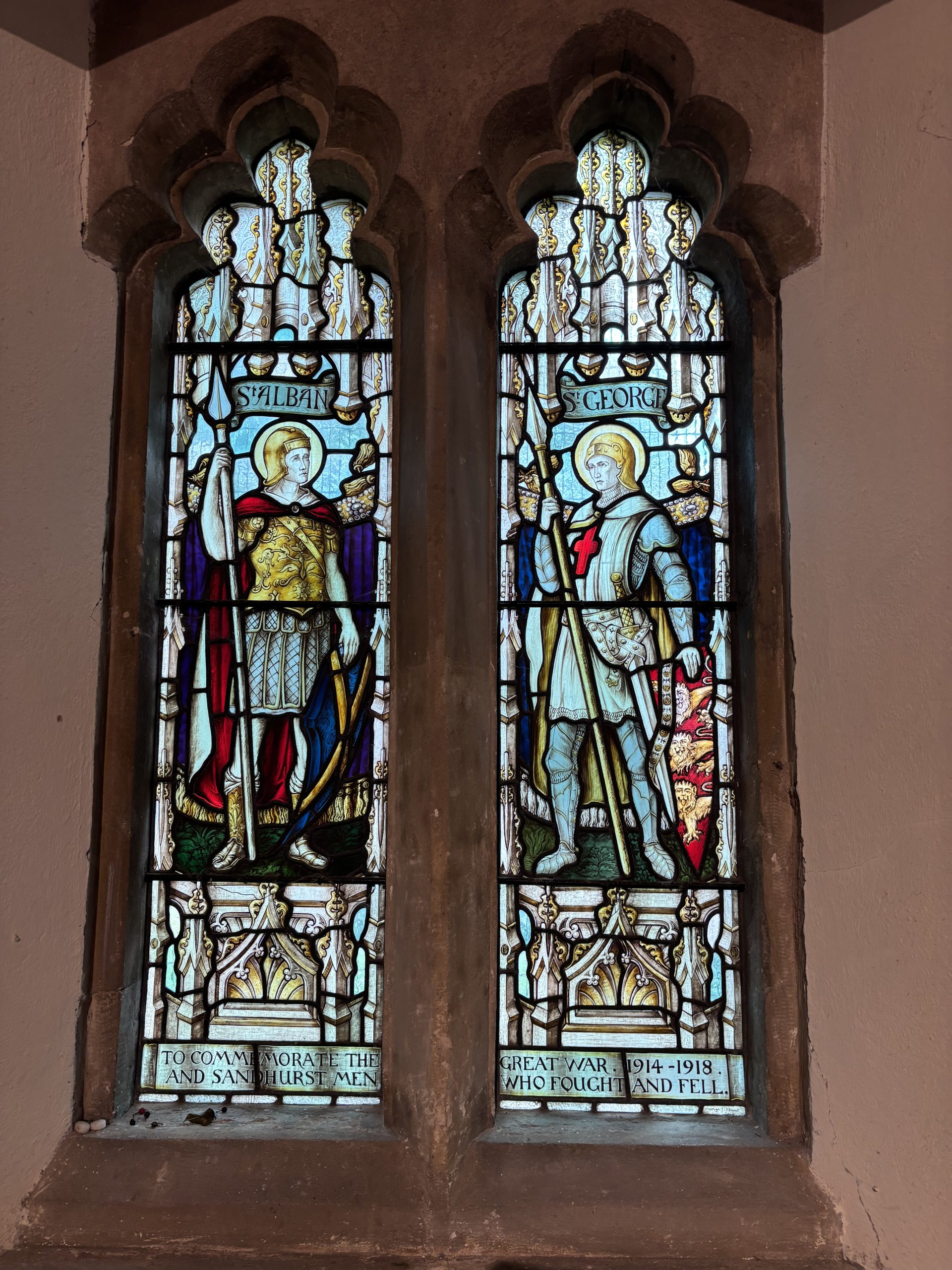
Stained Glass Windows: The window near the pulpit was produced 1857/1858 by Hardman and shows St George and St Alban. John Hardman & Co. was a Birmingham-based firm which began making stained glass in 1845. They were one of the country’s leading manufacturers of stained glass in the 19th and 20th centuries, creating windows for churches and houses all over the world. The company created ‘The Creation and Fall’ West Window in Worcester Cathedral.
There is also a window by Harry Stammers, added in 1947. Harry James Stammers (13 October 1902 – 21 August 1969) was an English stained glass artist and master glass painter whose body of work comprised more than 180 windows, primarily ecclesiastical commissions for Church of England buildings. Stammers’ work combined traditional craftsmanship with a personal response to modernism and twentieth-century religious practice.
Medieval Piscina: On the south side of the of the chancel, below the stained glass window (when the sun shines through this the rainbow of colours is wonderful!) is a scalloped indentation with a circular drainage hole at centre. This is a Medieval piscina in form of in sill of window right of altar. Dating mainly from the 13th century onward in Britain, these structures feature a drain hole that historically directed holy water directly into consecrated ground. They were used many years ago when washing the chalice and paten (the sacred vessels) following communion.
Church Bells: The tower contains a ring of eight bells cast by four different founders at five different times between 1596 and 1902.
The tenor (heaviest bell) weighs approximately 14 cwt (just over 700kg). The tenor and seventh bells are dated 1596 and cast by John Green of Worcester.
The sixth bell was cast in 1621 by John Palmar of Gloucester and is the only bell in Gloucestershire cast by him.
The third and fourth were cast by Abel Rudhall of Gloucester in 1751 and the fifth by Thomas Rudhall in 1768.
The treble and second bells were added by James Barwell of Birmingham in 1902.
The last QI in 2023 recommended only minor repairs and maintenance work, which has all been completed. However, more recently the organ has developed a number of faults and these are being addressed by a complete refurbishment of the organ and repairs to the associated speakers. This work was completed in Spring 2026.
Comprehensive audio-visual equipment with a mixing deck is installed and has been a huge benefit. Most services are shown on screen and the monthly family service is accompanied by the band. A group of men & women, the Church Yard Working Party, meet most Monday morning to maintain the churchyard in an excellent condition; a band of flower arrangers provide floral arrangements throughout the year; a cleaning rota with some 40 volunteers keeps the church building hoovered, polished and dusted!
Events through the year
- Harvest Supper – this year on Saturday 3rd October 2026
- Lunch Together – once a month from October – April we serve a hot 2-course meal for a very modest £5; enjoyed by about 30 local people as a chance to meet and chat with friends and neighbours over a leisurely meal.
- Songs of Praise – in 2025 Harvest Songs of Praise on 28th September
- Regular film nights – showing films such as The Rose of Auschwitz, Fisherman’s Friends, The Most Reluctant Convert, Pride, Book Club – the next chapter, The Wolf & The Lion, The Penguin Lessons , Jane (autobiographical about Jane Goodall); Finding Harmony: A King’s Vision
- Good Friday trail – in 2026 an eco trail collecting small samples of textured natural items which were then related to the Easter story
- Call My Bluff – do you know your wines? a social evening with a difference in June 2025. To be repeated on July 18th 2026